
By Cliò E. Agrapidis, PhD, RTDS Group
This year’s FFG Forum shined a spotlight on Europe’s deep tech future, bringing together thought leaders, innovators, and policymakers to explore what’s next in technology, collaboration, and competitiveness. From quantum and AI to life sciences and advanced manufacturing, the discussions revolved around the key enabling technologies that will shape Europe’s competitive edge in the years to come. And at the heart of it all was a powerful reminder: innovation is not just about technology. It’s about community—the people, ideas, and resources that come together to transform breakthroughs into real-world impact.
A Call for Confidence, Responsibility, and Excellence
In his opening remarks, the Austrian Federal Minister for Economy, Energy and Tourism, Wolfgang Hattmannsdorfer, stressed three qualities Europe must embrace to stay strong in a rapidly shifting global environment:
- Confidence in our scientific and industrial capabilities,
- Responsibility in shaping ethical frameworks, and
- Excellence in turning research into impact.
These guiding principles framed the two most dynamic conversations of the Forum: the future of quantum technologies and closing Europe’s AI gap.
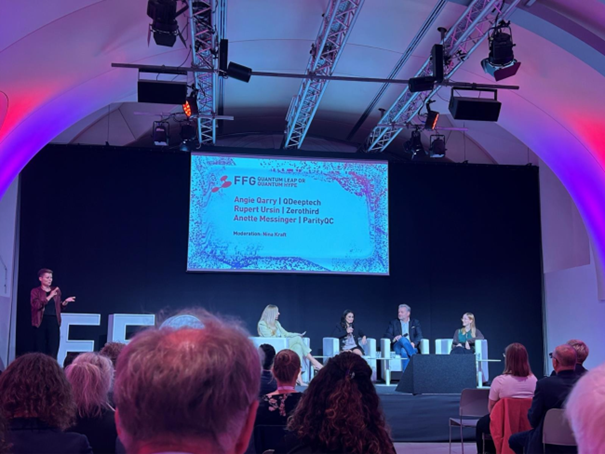
Quantum: Hype or Leap Forward?
One of the most anticipated discussions, “Quantum Leap or Quantum Hype?”, brought together experts Angie Qarry (QDeepTech), Rupert Ursyn (zerothird), and Annette Messinger (ParityQC).
They explored the opportunities and challenges of Europe’s quantum future, across three main domains:
- Quantum computing,
- Quantum communication and cryptography.
As Angie Qarry reminded the audience, “Quantum communication is already on the market, but many stakeholders don’t realise it.”
While algorithms are progressing quickly, the hardware still lags behind the scale needed for real-world quantum advantage. “If there are no software improvements, we need 5–10 years,” noted Annette Messinger. “But with algorithmic advances, it might be earlier for some applications.”
Europe is already a leader in quantum key distribution (QKD), with Austria and the EU hosting world-class providers. The European Commission’s EuroQCI initiative is laying the groundwork for a pan-European quantum communication infrastructure, and its quantum strategy aims to position Europe at the forefront of the race for the first practical quantum chip.
The stakes could not be higher. A functioning large-scale quantum computer would render today’s RSA encryption obsolete, with profound consequences for finance, government, and defence. “We cannot wait until a quantum computer is ready—that would already be too late,” warned Rupert Ursyn.
Experts agreed that Europe’s leadership depends on:
- Sustained funding streams,
- Efficient IP transfer from academia to industry,
- A DARPA-style initiative to accelerate breakthroughs.
The consensus: Europe has the talent, the industrial base, and the political will. What’s needed now is alignment across research, industry, and policy to turn hype into a true leap forward.
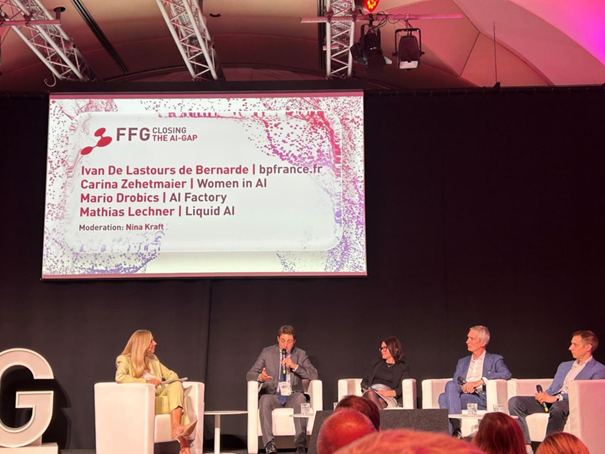
Closing the AI Gap
The fast-paced world of deep tech doesn’t stop at quantum. AI was front and center at the panel “Closing the AI Gap”, featuring Ivan De Lastours de Bernarde (BPI France), Mario Drobics (AI Factory), Mathias Lechner (Liquid AI), and Carina Zehetmaier (Women in AI). Here, the challenge was clear: Europe trails far behind the US and China in AI financing. As Ivan De Lastours noted, “Europe is 10–20 times smaller than the US in AI financing. The biggest European fundraiser was €1.7 billion compared to $50 billion in the US.” And yet, Europe has a unique opportunity. By embracing responsible, human-centric AI, the EU can transform regulation into a competitive advantage. “Regulation provides the framework to establish trust—this is what differentiates us from the competition,” argued Mario Drobics.
Carina Zehetmaier put it succinctly: “Ethical AI can be a competitive advantage.”
Austria at the Crossroads of Quantum and AI
Austria plays a pivotal role in Europe’s deep tech ecosystem. Innsbruck has become a hub for quantum algorithms and hardware, while Vienna is known worldwide as the birthplace of digital humanism. Together, they provide fertile ground for advancing both quantum and AI technologies.
The message from the Forum was clear: Europe is equipped with the science, talent, and vision. The next step is ensuring that cutting-edge technologies move swiftly from lab to market.
RTDS: From Vision to Market Impact because shaping the future isn’t just about invention
The conversations at the FFG Forum made one thing clear: Europe’s future in deep tech will depend not only on breakthrough research, but on our ability to translate science into solutions.
At RTDS, we know that brilliant research deserves more than recognition—it deserves real-world impact. By bridging the gap between research and exploitation, RTDS helps Europe’s innovators go further, faster
With more than 20 years of expertise, we guide research teams, SMEs, and industry leaders through every stage of the innovation journey—by
- Securing EU funding and de-risking ambitious projects
- Building powerful consortia across academia and industry
- Fast-tracking commercialisation from lab to market
- Managing complex collaborations, to ensure tangible market uptake.
If you’re working in quantum, AI, or other deep tech fields, don’t let your ideas stall at the proof-of-concept stage. Partner with RTDS and let’s turn your vision into Europe’s next success story.
© Title image: Shutterstock