
Earlier this October, RTDS Group attended the second day of the Vienna Quantum Tech Days, where leading voices from research, industry, and policy gathered to discuss the future of quantum technologies in Europe. On the same day, a notable development was the launch of Nord55, a Danish VC fund dedicated solely to quantum technologies—marking a shift toward broader European investment beyond national boundaries.
The Vienna event offered a clear signal: Europe is preparing to take its next major step with the Quantum Act, expected to be launched in 2026.

Quantum Act 2026: What It Means for Europe
The Quantum Act will be a cornerstone of Europe’s quantum strategy, designed to:
- Consolidate efforts across infrastructure, industrialisation, and ecosystem development.
- Support initiatives such as EuroHPC, EuroQCI, IRIS, and the Quantum Internet Initiative.
- Accelerate the transition from research to market.
Key takeaway: Europe must overcome fragmentation and scale up its quantum capabilities. While strong in academic research and startups, the continent still lacks large-scale hardware providers and sufficient venture capital. Hybrid funding models and public-private partnerships will be essential to ensure competitiveness and prevent startup relocation.
Collaboration in Action: From Research to Real-World Impact
One of the most compelling success stories came from Clement Utschig of Boehringer Ingelheim, who shared how collaboration between industry and academia is already delivering results. Working with QCWare and PsiQuantum, his team reduced quantum molecular simulations from three days to just sixteen hours—bringing pharma closer to real-time insights.
This partnership was sparked by earlier research that caught the attention of the academic community, demonstrating how visibility and collaboration can open doors across sectors. The use case is clear: quantum computing has the potential to revolutionise molecular dynamics, enabling pharma to simulate complex interactions more accurately and efficiently. It’s not just about more qubits—it’s about smarter algorithms and faster results. As Utschig said “stop thinking classically, start thinking quantum”.

Building a Resilient European Quantum Ecosystem
The event also showcased efforts to strengthen Europe’s quantum ecosystem. Quantum Delta NL presented its integrated approach, combining testbeds, talent centres, and national branding under one umbrella. Their “one-stop shop” model was praised as a blueprint for other countries.
Panelists including Iñaki Barettini (ICFO – Institut of Photonic Sciences), Richard Küng (Johannes Kepler University Linz), Tatjana Wink (Munich Center for Quantum Science and Technology), Anu Unnikrishnan (Quantum Center at ETH Zurich), and Andreas Poppe (Celare Quantum Technologies) explored the structural and collaborative dynamics shaping quantum research in Europe. While regional diversity presents coordination challenges, it also fosters innovation through varied approaches and local strengths. The consensus: cooperation across borders is essential, and EU programmes remain a powerful tool to foster collaboration.
Quantum for Defence and Infrastructure
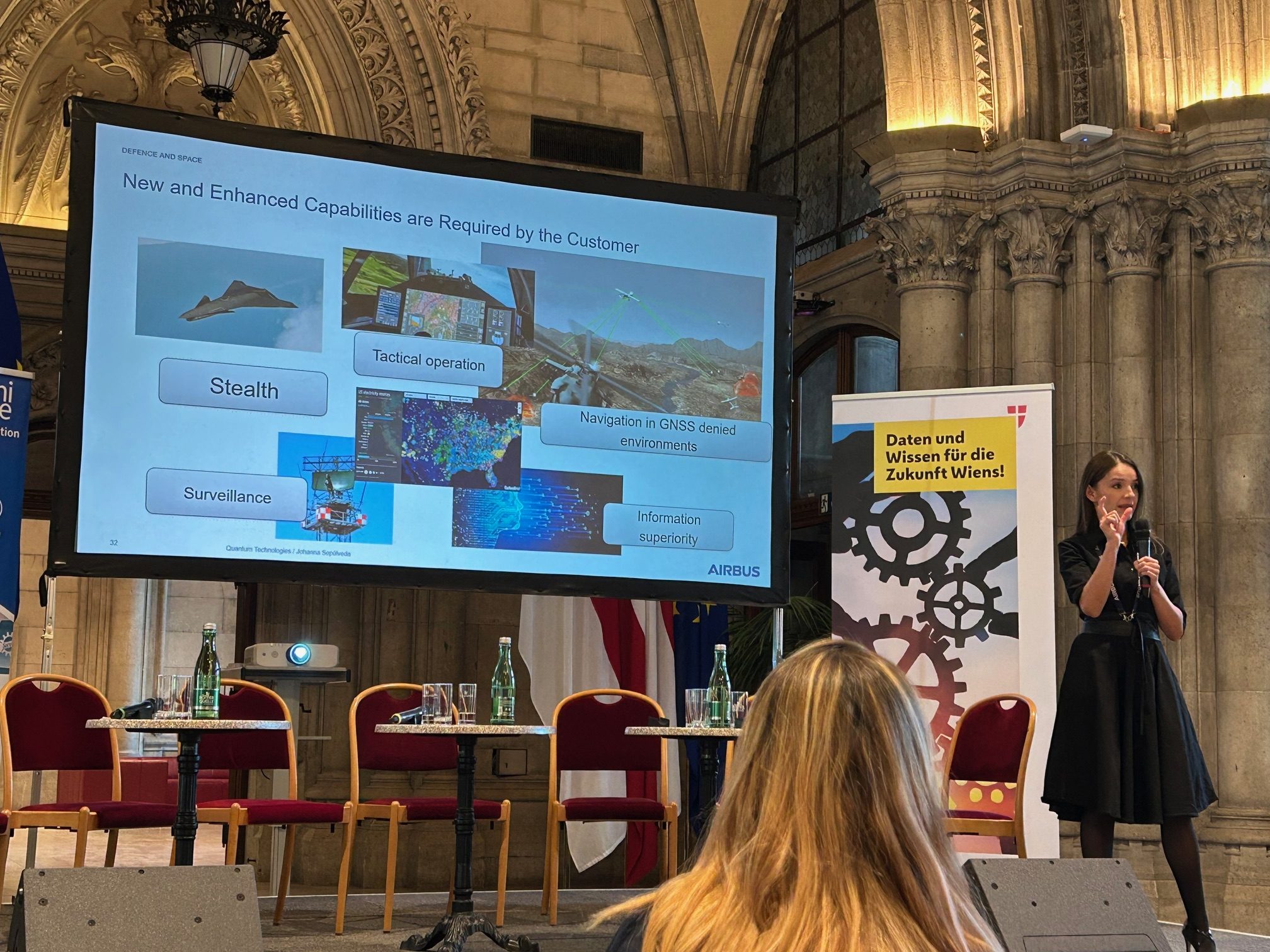
Airbus, represented by Johanna Sepulveda, shared its roadmap for integrating quantum into civil, military, and space domains. Their work spans quantum sensing, post-quantum cryptography, and leadership in EuroQCI deployment, including building optical earth stations and satellites for secure quantum communication.
The message was clear: customers don’t ask for quantum—they ask for solutions. Quantum must prove it’s the best one.
Quantum Meets AI: Opportunities and Caution
The intersection of quantum and AI was another key theme. Richard Küng explored how quantum computing could tackle hard problems in AI, and how AI might optimise quantum algorithms. His talk offered both excitement and caution: while the potential is vast, overhype must be avoided.
Quantum for AI could enhance optimisation and simulation, while AI for quantum could improve algorithm design, control, and certification. The idea of fully quantum AI—rethinking AI at the quantum level—is still speculative but worth watching.
RTDS: Your Partner in Quantum Innovation
RTDS Group is deeply embedded in the European landscape. We understand the challenges, the opportunities, and the funding mechanisms that can bring your quantum ideas to life. Whether you’re working on sensing, computing, communication, or AI integration, RTDS is ready to support your proposal in any field of quantum technologies.
Let’s build the future of quantum—together.